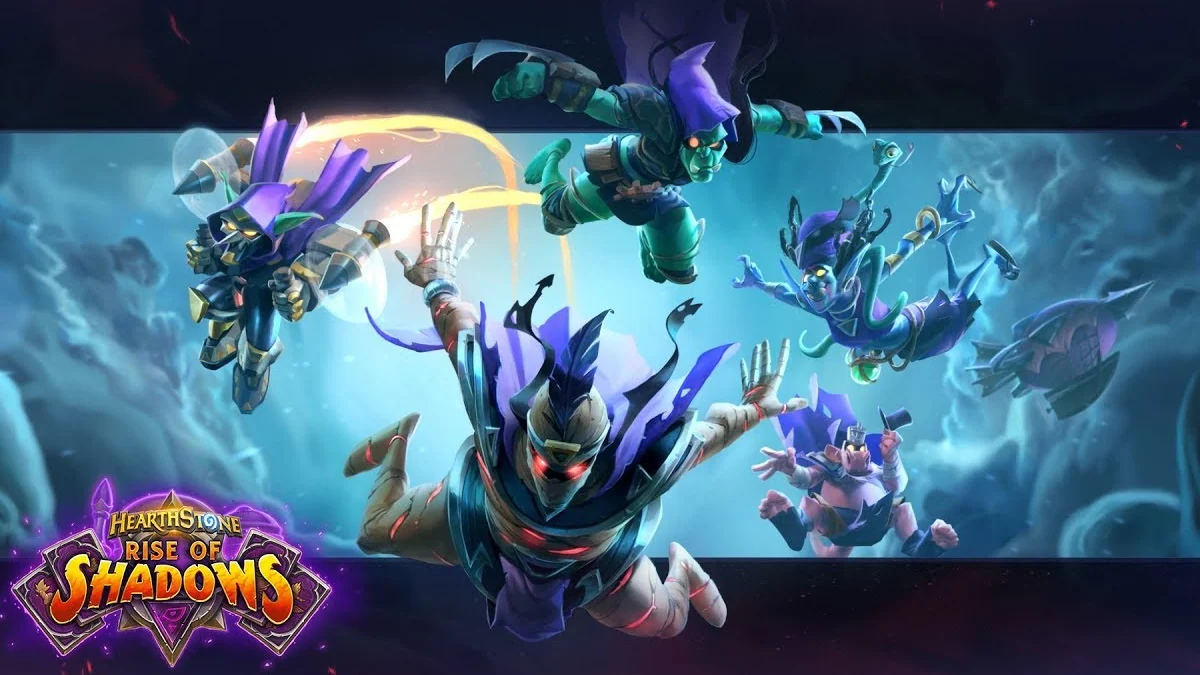
Hearthstone is an excellent example of a free-to-play online game developed by Blizzard, featuring a highly effective monetization model and a long-running, successful lifespan. For those unfamiliar with the title, Hearthstone is a card game that was first released in 2014. The launch of its latest expansion, Rise of Shadows, has drawn me back to the game.
With every new expansion, the Hearthstone meta—the state of the game—undergoes significant shifts. This is crucial for keeping veteran players engaged by presenting them with fresh challenges. However, for those who haven’t played in a while, the barrier to entry can be quite high. This is precisely why I prefer the single-player modes in Hearthstone expansions over the multiplayer experience.
Blizzard’s strategy is to introduce new cards to the multiplayer mode first, followed by the release of single-player content. I fully intend to write about the Rise of Shadows single-player mode once it goes live in May. It looks incredibly promising; it’s said to feature a narrative that spans three consecutive expansions, which should serve as a fantastic hook for new players to give Hearthstone a try.
That said, if you aren’t a regular player, the multiplayer mode can feel rather overwhelming. I played Hearthstone frequently back in 2014 and early 2015, but then took a long break. I recently returned to the game—primarily to check out The Boomsday Project and its single-player “Puzzle Lab”—but I’m left with the same impression I have now: the multiplayer landscape has changed so much that it’s quite difficult to jump back in.
Hearthstone constantly updates its card pool to keep the gameplay fresh. It does this by rotating out older cards as new ones are introduced. If you return to the game after missing a few expansions, you’ll find yourself lagging behind other players, which makes the entry barrier somewhat steep.
To be clear, however: you don’t necessarily have to spend money to win in Hearthstone. Many players choose to play for free, but acquiring new cards—and being able to compete against some of the most powerful decks in the game—requires a significant time investment. For most new players, the real challenge lies in accepting that Hearthstone demands a great deal of practice before one can truly grasp its mechanics and enjoy the multiplayer experience.
Many players try a shortcut to get started: they copy other players’ decks, hoping to secure wins that way. While this can certainly help you get up and running quickly, the most crucial skills in Hearthstone—understanding deck balance and knowing exactly when to play specific cards—cannot be acquired simply by copying someone else’s deck.
Another issue with copying deck lists is that new players—having spent relatively little time in the game—may not actually own the required cards, as they haven’t had the chance to pull them from card packs (a mechanic similar to opening loot boxes). While one could purchase packs to speed up the process, it’s quite expensive. In the Rise of Shadows expansion, a bundle of two packs—each containing five cards—costs $2.99 (approximately 200 rupees), while a bundle of 60 packs is priced at $69.99 (approximately 4,900 rupees).
Since many of the cards you pull will be duplicates, it’s best not to try and acquire all 130 new cards from Rise of Shadows through purchases alone; you can eventually obtain them just by playing the game. Upon logging into Hearthstone, I did receive some messages from the developers explaining recent changes, but I don’t feel this information is sufficient for players who have been away from the game for a long time.
For many, the time and practice required to get back into Hearthstone can be a bit overwhelming. I experienced this firsthand when I returned to play during the Rise of Shadows expansion. I found myself searching online for player-created decks to understand the current strategies, only to realize I had to relearn a whole host of terminology. Fortunately, the official Hearthstone website features a very helpful page showcasing all the cards from Rise of Shadows, allowing me to study them closely and gradually acquire the ones I wanted.
As I mentioned earlier, it had been a long time since I last played Hearthstone, which naturally shaped my experience with the game. With so many classes to choose from, I had to review the available cards for each one before I could build a decent deck and attempt to compete. I spent some time practicing in single-player modes to familiarize myself with each class, eventually settling on a few that I really enjoyed.
Rise of Shadows introduces some intriguing new mechanics with significant potential. Certain “Scheme” cards grow more powerful as the game progresses. For instance, “Dr. Boom’s Scheme” grants your hero 1 Armor, with the value increasing by 1 for every turn it remains unused in your hand. If you acquire “Dr. Boom’s Scheme” and hold onto it for five turns, playing it will grant your hero 5 Armor—potentially enough to save you from a lethal blow. Similarly, “Rafaam’s Scheme” summons a 1/1 Imp, with the number of summoned Imps increasing with each passing turn. When combined with other cards in your deck, these Scheme cards can create incredibly potent synergies.
Another new mechanic is “Twinspell,” which adds a copy of the spell to your hand, effectively allowing you to cast it a second time. The game also features “Lackey” minions—low-stat units (with minimal Attack and Health) that boast powerful Battlecries (effects that trigger when a card is played), such as adding two more Lackey cards to your hand.
These mechanics are quite well-designed, and they led to some fascinating scenarios during my time with Rise of Shadows. In one match, I failed to play a single minion for five consecutive turns and suffered a crushing defeat; by the time I could react, it was already too late to counter my opponent’s strategy. This was largely due to a poorly constructed deck—it contained too many cards with a mana cost of five or higher, which were unplayable during the early stages of the game.
Once I addressed this issue, my overall experience improved, even if my win rate didn’t see a dramatic boost. That said, I still found myself spending a disproportionate amount of time deciphering various game terms just to build a decent deck. For example, I had to relearn the definitions of keywords like “Lifesteal,” “Silence,” and “Secret.” While these terms appear on the cards, their descriptions are often too brief to convey how they actually function in gameplay, forcing me to consult external guides to fully grasp them. The ideal strategy for getting into Hearthstone these days is probably to start by playing plenty of single-player matches (against the AI) to get familiar with the cards and build a decent deck using the basic set, before moving on to multiplayer. Personally, I find this process a bit too time-consuming. If that doesn’t bother you, Hearthstone remains a highly engaging game that can keep you hooked for a long time. For me, however, it’s not quite the right fit—so I plan to wait until the single-player content for the “Rise of Shadows” expansion is released before really diving in.